Almost every day I find myself looking at a website and thinking, "This was AI-generated." I usually say it with a bit of judgment, even though I use AI myself to generate designs.
The interesting thing is that websites have always shared similar characteristics. We have always had templates and design systems for building websites. The difference was that someone had put effort into creating those templates, and someone else had adapted them to their own website. Now, everything can be created with just a few prompts and clicks, and as a result, the internet is becoming more uniform, less creative, and more boring.
Before AI: The Evolution of Web Design
Design trends have always changed throughout different eras of the web. Just like fashion, websites followed what was considered modern at the time.
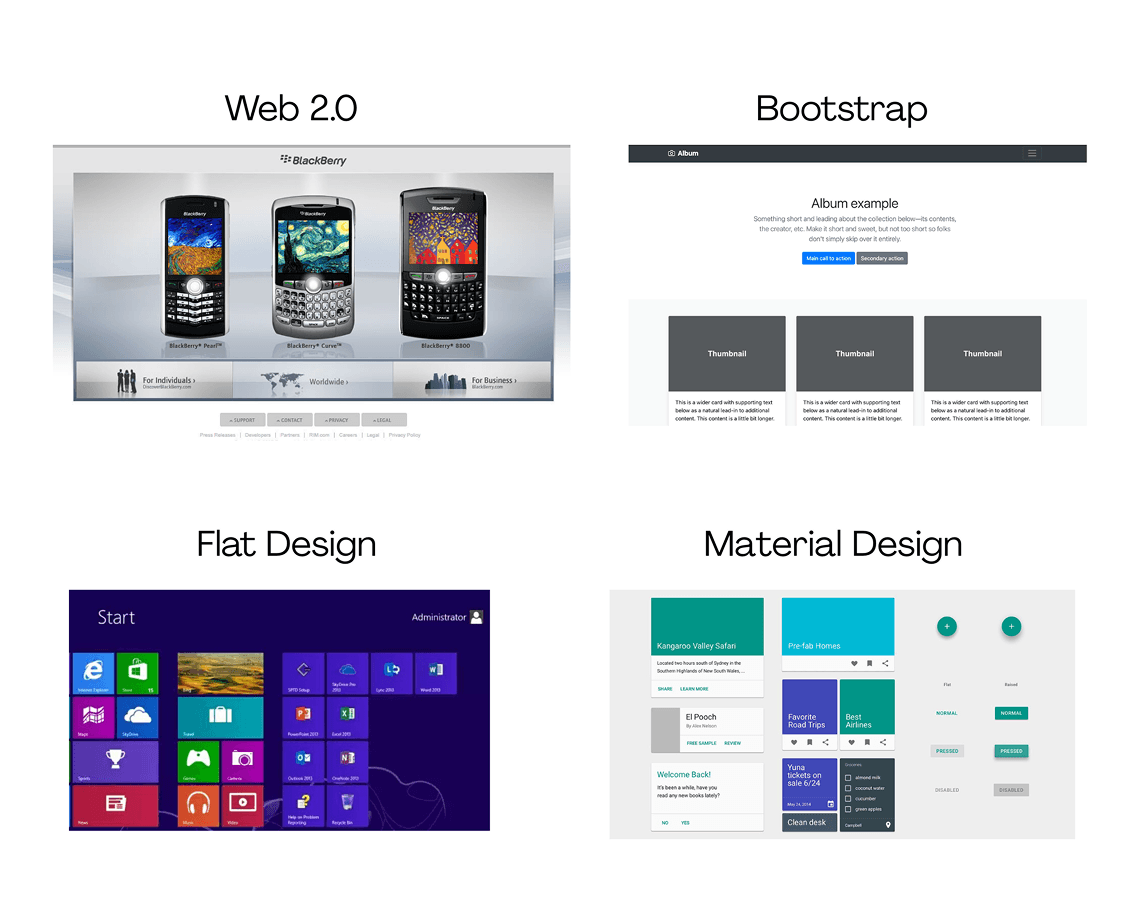
The Web 2.0 era, between 2005 and 2010, was defined by glossy buttons, rounded corners, large soft sans-serif logos, bright colors, blue gradients, and plastic-like reflections. At the time, this represented modern design, and almost everyone was using this style.
Around 2011, Bootstrap became popular and introduced recognizable dashboard layouts, cards, and navigation bars. Websites started using a 12-column responsive grid and consistent spacing. Bootstrap made website development faster and cleaner while introducing a level of minimalism that did not exist during the Web 2.0 era.
In 2013, Flat Design became the dominant trend. Shadows and textures disappeared, and interfaces became simpler, geometric, and minimalistic. Microsoft's Metro design and Apple's iOS 7 redesign became the most recognizable examples.
In 2014, Material Design brought shadows back, but with a different purpose. Instead of decoration, shadows represented elevation and layers, similar to sheets of paper. Floating action buttons, clean typography, and ripple animations became widely used across the web.
Between 2017 and 2021, Corporate Memphis (or Alegria) illustrations were everywhere. They featured people with elongated bodies, small heads, unusual proportions, and colorful abstract shapes.
Around the same time, SaaS landing pages became the standard format that is still everywhere today. A typical SaaS website includes a hero section with a headline and two buttons, feature cards, testimonials, pricing tables, FAQs, and a footer. The web is now full of these websites, and I have built many of them myself. Even before AI, these layouts were completely normal because they contained all the information businesses needed to communicate with their users.
All of these examples are exactly what they sound like: trends. People followed popular styles, designers created variations, and eventually something new replaced them.

Why AI Websites Look the Same
When we ask AI tools to create a design today, they usually generate the design pattern that is most likely to be used for that situation. If we ask for a SaaS website, we will probably get a SaaS website with all the familiar sections mentioned above, because that pattern is one of the most common structures on the internet.
The most popular frontend tools today are Tailwind CSS and shadcn/ui, and millions of websites are built with them. Tailwind's default indigo bg-indigo-500 button has almost become a symbol of AI-generated design. Not because Tailwind created bad design, but because it is one of the most widely used CSS frameworks today
shadcn/ui also provides default styled components. When developers install it and keep the default settings, AI tools working on that project naturally continue following those same patterns. AI agents follow existing patterns, frameworks, and rules they were trained on and don't invent new visual languages.
AI Is Not a Designer
Website generators like Lovable, v0, and Base44 also rely heavily on existing frameworks and popular design patterns. Since they generate millions of websites using the same foundations, the results naturally start looking similar. Those generated websites then become part of the internet that future AI models learn from, creating a cycle where the same patterns are repeated again and again.
The difference between previous design trends and AI-generated design is that previous trends had a source. Someone decided that buttons should become flat or that cards should have floating shadows. There was a moment of originality behind those decisions. Yes, those ideas were copied afterward, but someone created them first and established the rules others followed.
AI works differently. It does not create something new from nothing. It calculates the patterns that already exist and generates another version of them. AI is not the author. It is an average of everything that already exists.
The Future of Web Design
Design trends naturally evolve. Every few years, something new refreshes the web and changes how websites look.
With AI-generated design, this evolution becomes much harder because AI creates variations of what already exists rather than inventing something new. It doesn't move the web forward. AI is not a design trend that develops over time. It is a copy that keeps copying itself.